

Long before it was a therapeutic technique, alternating left-right stimulation was simply… life.
Humans develop and function through rhythmic left-right patterns:
- babies crawl (left-right)
- we walk, run, hike (left-right)
- we swim, drum, dance, ride a bike (left-right)
Bilateral coordination is part of everyday regulation, and humans are hardwired to intuitively leverage it — think of pacing when anxious, rocking, or going for a walk to “clear your head.”

Occupational therapy and bilateral coordination
In the 1960s, occupational therapists started to develop bilateral coordination exercises to support development for kids who struggled with early milestones (like crawling) or had coordination and learning challenges, and for adults to regain function, for example after a stroke or traumatic brain injury.
A key concept here was crossing the midline: moving one side of the body across the center line to the other side, or coordinating alternating sides.
Why that focus? In simple terms: the brain has two hemispheres. The anatomical “bridge” between them is the corpus callosum. Occupational therapists designed exercises that repeatedly engage this bridge for cross-body integration.
So one of the most important origin threads for BLS comes from occupational therapy in pediatrics and for neuro-rehabilitation.

EMDR: Bilateral stimulation becomes a breakthrough tool for PTSD sufferers
Walking through a park in 1987, Psychology PhD student Francine Shapiro noticed that her level of stress seemed to decrease with certain eye movements. Shapiro tested this on friends and colleagues, guiding their eye movements, and they reported a similar effect. Shapiro went on to create an Eye Movement Desensitization and Reprocessing protocol, in short EMDR, and published her first study in 1989 showing that EMDR significantly reduced distress in Vietnam war veterans.
Since then, the efficacy of EMDR for treatment of trauma has been replicated in more than 30 randomized controlled trials and supported in meta-analyses (e.g. [1] – [5]).
EMDR has provided a breakthrough in trauma treatment and is recognized as an evidence-based treatment for PTSD by the World Health Organization (WHO), the American Psychological Association (APA), the U.S. Department of Veterans Affairs and Department of Defense, and the UK’s National Institute for Health and Care Excellence (e.g. [6] – [8]).
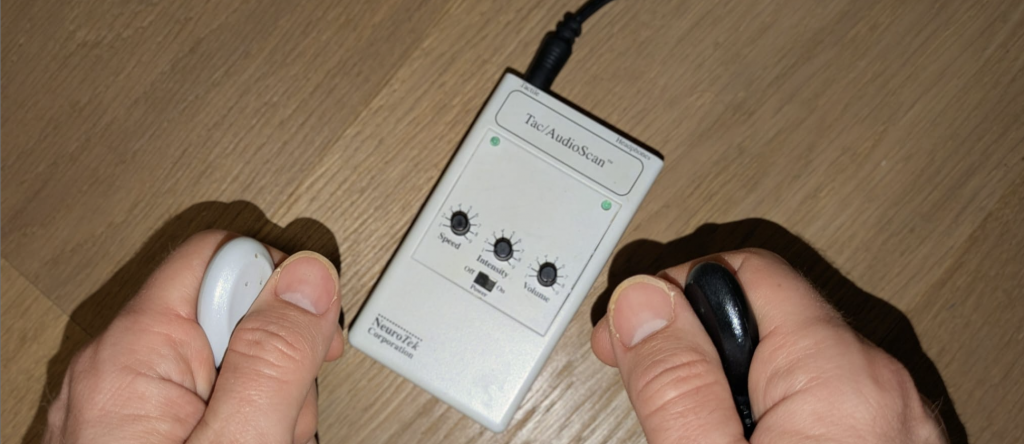
New ways of delivering bilateral input
Over time, research showed that eye movements were not the only way to deliver bilateral stimulation for EMDR — alternating tapping or audio tones proved just as effective. Read more about how bilateral stimulation is delivered today.

BLS today: beyond therapy
Several practical forces pushed BLS beyond EMDR sessions:
a) The mental health bottleneck
With therapists maxed out and waitlists long, people have been looking for tools that help them settle their nervous system, and to cope better between sessions.
b) BLS for stabilization and grounding
Clinicians began using bilateral tapping or tones not only for reprocessing, but as a stabilization / grounding resource: something that can help reduce arousal without digging into trauma content. One seminal work in this area is clinical psychologist Dr. Laurel Parnell’s book Tapping In, which describes how to self-apply BLS in a non-trauma context.
c) BLS goes Spotify and YouTube
Clinical psychologist Mark Grant started distributing bilateral soundtracks in the 1990ies as CDs within the EMDR community. Much later both he and psychotherapist Dr. David Grand eventually published soundtracks on Spotify and YouTube, making BLS for self-help broadly accessible.
From those beginnings a huge self-help BLS online community emerged, with the most popular videos, e.g. from Destined Dynamics, stacking up several millions of views.
Here it’s important to note that, while bilateral stimulation can be used for self-regulation, trauma processing should still be only be undertaken with licensed therapeutic support.
In Conclusion
Bilateral coordination has been part of human regulation since the beginning. We do it every day. Then EMDR made it clinically powerful by applying it within a protocol designed for trauma processing. Today, we’re seeing a broader, more pragmatic view emerge: BLS as a sub-clinical stabilization tool for everyday self-use.
References
[1] Bisson, J. I., Roberts, N. P., Andrew, M., Cooper, R., & Lewis, C. (2013). Psychological therapies for chronic post-traumatic stress disorder (PTSD) in adults. Cochrane Database of Systematic Reviews, 2013(12), CD003388. https://doi.org/10.1002/14651858.CD003388.pub4
[2] Bisson, J. I., Roberts, N. P., Andrew, M., Cooper, R., & Lewis, C. (2018). Psychological therapies for chronic post-traumatic stress disorder (PTSD) in adults (Update). Cochrane Database of Systematic Reviews, 2018(5), CD003388. https://doi.org/10.1002/14651858.CD003388.pub4
[3] Chen, Y.-R., Hung, K.-W., Tsai, J.-C., Chu, H., Chung, M.-H., Chen, S.-R., Liao, Y.-M., Chang, Y.-C., & Chou, K.-R. (2014). Efficacy of eye-movement desensitization and reprocessing for patients with posttraumatic stress disorder: A meta-analysis of randomized controlled trials. PLOS ONE, 9(8), e103676. https://doi.org/10.1371/journal.pone.0103676
[4] Cusack, K., Jonas, D. E., Forneris, C. A., Wines, C., Sonis, J., Middleton, J. C., Feltner, C., Brownley, K., Olmsted, K. R., Greenblatt, A., Weil, A., & Gaynes, B. N. (2016). Psychological treatments for adults with posttraumatic stress disorder: A systematic review and meta-analysis. Clinical Psychology Review, 43, 128–141. https://doi.org/10.1016/j.cpr.2015.10.003
[5] Lee, C. W., & Cuijpers, P. (2013). A meta-analysis of the contribution of eye movements in processing emotional memories. Journal of Behavior Therapy and Experimental Psychiatry, 44(2), 231–239. https://doi.org/10.1016/j.jbtep.2012.11.001
[6] National Institute for Health and Care Excellence. (2018). Post-traumatic stress disorder (NICE Guideline NG116). https://www.nice.org.uk/guidance/ng116
[7] U.S. Department of Veterans Affairs & Department of Defense. (2023). VA/DoD clinical practice guideline for the management of posttraumatic stress disorder and acute stress disorder. https://www.healthquality.va.gov/guidelines/MH/ptsd/
[8] World Health Organization. (2013). Guidelines for the management of conditions specifically related to stress. World Health Organization. https://www.who.int/publications/i/item/9789241505406
Schreibe einen Kommentar