

Waven is a VR experience that uses multi-sensory bilateral stimulation to support calm and rest.
An early alpha release will soon be available on Meta Quest 2, 3, and 3S.
What is Bilateral Stimulation?
Bilateral Stimulation (BLS) is a well-established and well-researched technique for nervous system regulation.
BLS involves taps, sounds, visuals, or movement alternating between the left and right sides of the body to promote relaxation, calm, and reduce stress when used independently — or, as part of structured therapeutic work, to support the treatment of Post-Traumatic Stress Disorder (PTSD).
BLS does not require talking, interpretation, or belief.
Why Bilateral Stimulation in Virtual Reality?
Virtual Reality (VR) enables three things that have previously been impossible with BLS:
Engage sight, hearing, and touch simultaneously…
…while (virtually) traveling to a calm place, a process known as Resourcing…
…within a single customizable, easy-to-use app
Traditionally, these elements exist separately in different tools, or only in the imagination.
In VR, they can be experienced together, in sync.
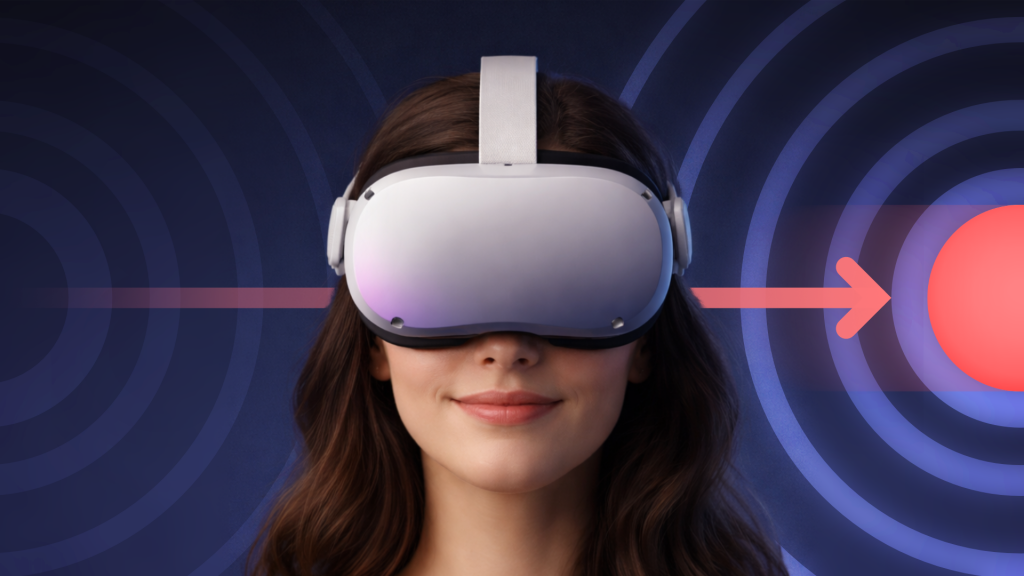
Multi-sensory
BLS engages attention in a steady, non-demanding way. Traditionally, stimulation is either visual, auditory, or tactile — one modality at a time.
VR allows sight, sound, and touch to be experienced in synchrony, without requiring multiple devices or another person.

Resourcing
In therapy, BLS is often paired with techniques such as imagining a calming place — a process known as resourcing.
In VR, users can choose to immerse themselves in that place, rather than having to construct and maintain it in their imagination.
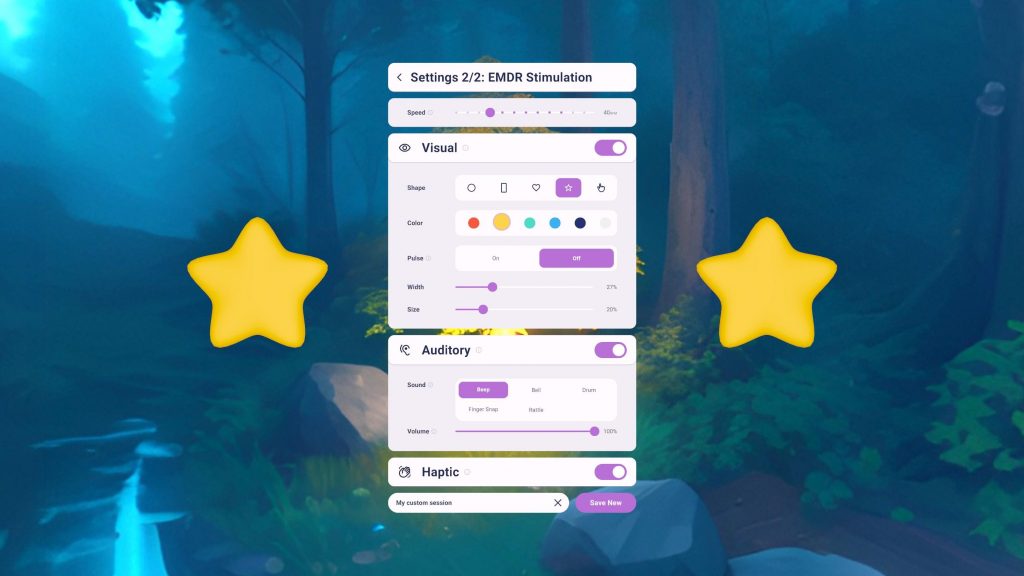
Personalization
BLS is highly individual — what feels calming varies from person to person, and from day to day. Existing tools offer limited options beyond speed adjustment.
Waven allows VR users to tailor visual, auditory, and tactile elements in an easy-to-use and intuitive VR app.
Waven is designed to explore whether multi-sensory BLS together with immersive resourcing can produce a deeper and faster relaxation response. Explore it with us!
Waven started as a personal tool. I had benefited greatly from bilateral stimulation sessions with a licensed EMDR therapist. But then I moved to Europe and lost access to my therapist. So together with friends, we began building something for ourselves for relaxation. I have been using Waven for a while now — when I feel my body tensing up, and to settle my mind after an activating day. We got curious if Waven can be helpful to others, too, so we are sharing Waven’s alpha version for free.

Britta | Co-founder
Learn more about bilateral stimulation
Learn more about the origins of BLS, how it is applied today, and when it is safe to use BLS without a therapist.
-
The Research
We’ll keep posting research papers here as we come across them. If you know of…
-
The Origins of Bilateral Stimulation (BLS): From Everyday Movement to Trauma Therapy to Self-Help Tool
Long before it was a therapeutic technique, alternating left-right stimulation was simply… life. Humans develop…
-
How bilateral stimulation is delivered today
In the late 1980s, psychologist Francine Shapiro observed that certain left–right eye movements appeared to…
Some people find visual input most effective, others respond more strongly to sound or touch. We are curious whether a multi-sensory approach like Waven makes bilateral stimulation more broadly accessible. Waven is highly configurable yet easy to use – you can pick which senses you want to stimulate today and how.

Alessia | Co-founder
Do you want to try out Waven for yourself?
Great! If you already have a headset, click here to join the waitlist!
Waven will initially release as a closed alpha. This means it’s still rough around the edges, and that we would love to hear from you – feedback, bug reports, ideas – to decide what to improve next.
Are you a therapist?
Great! We are interested in partnerships or advisory roles with licensed clinical practitioners or researchers in the field of EMDR-based trauma treatment. Reach out to us on hi@waven.app
EMDR is a clinically proven therapy for reducing post-traumatic stress—a method I’ve experienced firsthand. Our hypothesis is that engaging multiple senses simultaneously increases the load on working memory. When working memory is occupied, fewer cognitive resources are available for rumination, worry, or intrusive thoughts.
If this holds true, bilateral stimulation may also support rapid relaxation outside of trauma processing. Waven is our attempt to explore that possibility.

Sarah | Co-founder
Questions
Common questions around Bilateral Stimulation (BLS), Virtual Reality (VR) and Waven
No. Waven is not therapy and does not replace a therapist. It is a VR tool for delivering bilateral stimulation.
Do you answer the following questions with a ‘yes’?
1. Do you have a bit of VR experience?
2. Would you benefit from muscle relaxation or a calmer mind?
3. Are you open to trying out an early app version that’s not super polished and potentially comes with glitches?
Then we suggest you give Waven a try :). But please read “When should I NOT use Waven” first.
Waven is designed for regulation practice, not trauma processing. If you are currently working through severe trauma, experiencing significant dissociation, or feeling highly destabilized, please work with a licensed EMDR practitioner instead.
You should also speak with a healthcare professional before using Waven if you have a history of seizure disorders, significant neurological conditions, or if rhythmic visual or sensory stimulation has caused discomfort in the past.
Just like with meditation or other regulation practices, emotions can become more noticeable before settling. This is normal and healthy. However, if you notice no improvement after a while, stop the session.
If you’re unsure whether Waven is appropriate for you, consult a licensed clinician.
We’re a small team of VR veterans with a long-standing interest in EMDR-based trauma therapy. Waven was developed with feedback from a trained attachment-focused EMDR therapist with 15 years of clinical experience.
We’ve been privileged to access high-quality care, but many people can’t — demand far exceeds the number of available therapists, and geography, cost, and long wait times often determine who gets help and when. We don’t believe technology replaces therapy. But we do believe it can help broaden access to regulation practices that are often limited to the therapy room. Waven is our attempt at exploring expanding that access — responsibly.
This is just the start — we have very exciting things in the pipeline! :). Each step in our roadmap puts user safety first. And, each step will be informed by feedback from users and therapists. Feel free to reach out at hi@waven.app.
Among other things, we are inspired by the book Tapping in by Dr. Laurel Parnell who socialized the idea that carefully administered BLS is safe for self-use (we are not affiliated with Dr. Parnell in any way).
Waven is built in our spare time, and we want everybody to be able to try it. So yes, it’s currently free to download and there are no in-app purchases.
You need a VR headset. Waven currently runs on the following headsets: Meta Quest 2, 3 and 3S. You can buy a Meta quest at your nearest tech store or online. At the time of writing a Quest 3S is $269. (No, we don’t earn anything if you click that link).
Background and disclaimers
Waven is not an official implementation of any specific therapeutic protocol and is not endorsed by individual clinicians. The founders are users of BLS technology, not licensed clinicians.
Waven is not designed to treat trauma or any other medical or psychological condition. Waven does not replace treatment by a licensed medical professional. Please reach out to a licensed professional for treatment.
Join the waitlist!
We’ll notify you right away when Waven alpha is available!